Your conservatory is a wonderful addition to your home, a perfect bridge between indoors and out. It’s fantastic for soaking up the sun or watching a gentle rain. But let’s be real, as soon as the chill sets in, that beautiful glass room can quickly turn into the coldest spot around. To truly enjoy it all year, you need a dependable, efficient way to heat it.
That’s precisely where an electric panel heater shines. For small conservatories, they’re often the ideal solution, providing focused warmth without any plumbing or gas fuss. But with countless options available, how do you find the best electric panel heater for your small conservatory? It’s not just about grabbing any heater; it’s about choosing the perfect one for your specific space.
In this guide, we’re going to cover everything you need. We’ll walk you through calculating the right wattage, exploring various heater types, tackling tricky dwarf wall installations, and even managing running costs and condensation. By the time you’re finished reading, you’ll be fully equipped to pick a panel heater that transforms your small conservatory into a warm, inviting retreat, whatever the weather brings.
Structure Map
- Why Electric Panel Heaters Are Great for Small Conservatories
- How to Calculate the Right Wattage for Your Small Conservatory
- Understanding Different Panel Heater Technologies
- Low-Profile and Dwarf Wall Heaters: The Perfect Fit
- Detailed Running Costs: What to Expect in a Small Conservatory
- IP Ratings: Protecting Your Heater in a Conservatory Environment
- Smart Home Integration: Beyond the App
- Managing Condensation and Ventilation in Your Heated Conservatory
- Key Features to Look For
- Top Picks for Small Conservatories
- Installation and Placement Tips
- Frequently Asked Questions
- Final Thoughts
Why Electric Panel Heaters Are Great for Small Conservatories
Electric panel heaters really are a fantastic solution for warming up those often-chilly conservatory spaces. They’re typically slim, discreet, and don’t hog valuable floor space – a huge bonus in smaller rooms. Unlike bulky radiators or noisy portable fan heaters, panel heaters usually mount neatly to a wall, blending right into your décor.
They’re also incredibly straightforward to install. Just plug them into a power socket, and you’re set. No complex plumbing, no gas lines, and no annual boiler services to fret about. Most models come with built-in thermostats and timers, giving you precise control over your conservatory’s temperature and exactly when it heats up. This smart control means you’re only using energy when you actually need it, which helps keep those electricity bills from getting out of hand.
What’s more, many modern panel heaters operate silently. You won’t have a noisy fan whirring away when you’re trying to relax or read in your sunroom. Instead, they deliver a gentle, consistent warmth that makes the entire space feel comfortable, rather than just hot in one spot.
How to Calculate the Right Wattage for Your Small Conservatory
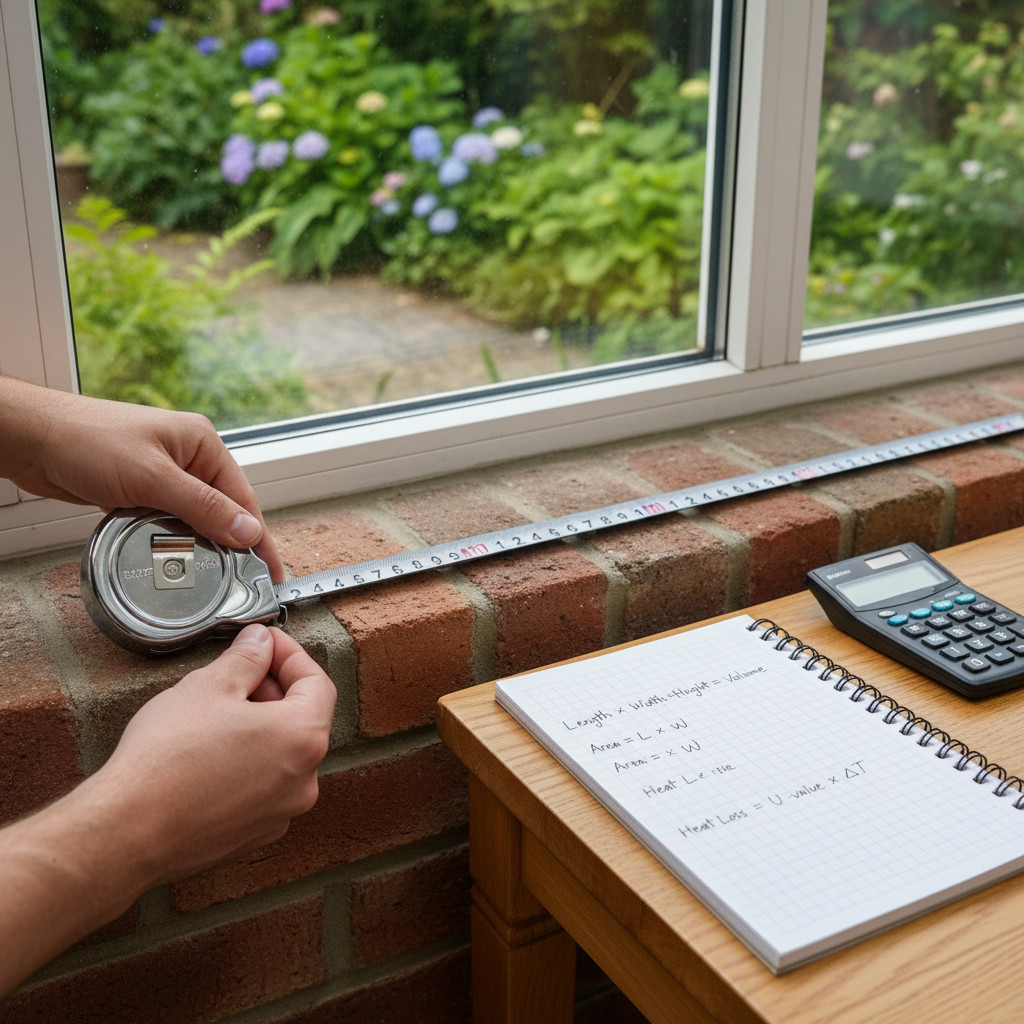
This is arguably the most crucial step. You could buy the fanciest heater on the market, but if it doesn’t have enough power (wattage) for your specific space, it simply won’t get warm enough. A “small conservatory” can actually vary quite a bit in size and how well it’s insulated, so we really need to get specific.
The general rule of thumb is to aim for around 100 watts per square meter (W/m²) for a well-insulated room. However, conservatories are inherently less insulated than the main part of your house, even with modern glazing. This means you’ll likely need more power.
Here’s a more realistic approach for a conservatory:
- Measure Your Conservatory:
- Length (m): Measure one side.
- Width (m): Measure the adjacent side.
- Height (m): Measure from floor to ceiling.
- Calculate the Volume:
- Multiply Length x Width x Height = Total Volume in cubic meters (m³).
- Assess Your Insulation Level: This is critical.
- Good Insulation: Modern double glazing (A-rated), insulated dwarf walls, insulated roof (not just glass). Use a factor of 80-100 watts per cubic meter (W/m³).
- Average Insulation: Older double glazing, brick dwarf walls, polycarbonate roof. Use a factor of 100-120 W/m³.
- Poor Insulation: Single glazing, thin walls, all-glass roof. This is common in older conservatories. You might need 120-150 W/m³ or even more.
- Calculate Required Wattage:
- Multiply your Total Volume (m³) by your chosen Insulation Factor (W/m³).
Let’s do an example for a “small conservatory”:
Imagine your conservatory is:
- Length: 3 meters
- Width: 2.5 meters
- Height: 2.4 meters
- Volume: 3m x 2.5m x 2.4m = 18 m³
- Insulation Assessment: Let’s say it’s an older conservatory with average double glazing and a polycarbonate roof. We’ll use an Insulation Factor of 110 W/m³.
- Required Wattage: 18 m³ x 110 W/m³ = 1980 Watts
So, for this example conservatory, you’d be looking for a heater (or a combination of heaters) that provides around 2000 watts of power.
Important Note: It’s always better to slightly over-spec than under-spec. An overpowered heater will reach the desired temperature faster and then cycle off, using less energy overall. An underpowered heater will struggle to reach the target temperature, constantly running at maximum, which is less efficient and won’t make your space truly warm. If you’re on the fence between two wattages, go for the higher one.
Understanding Different Panel Heater Technologies
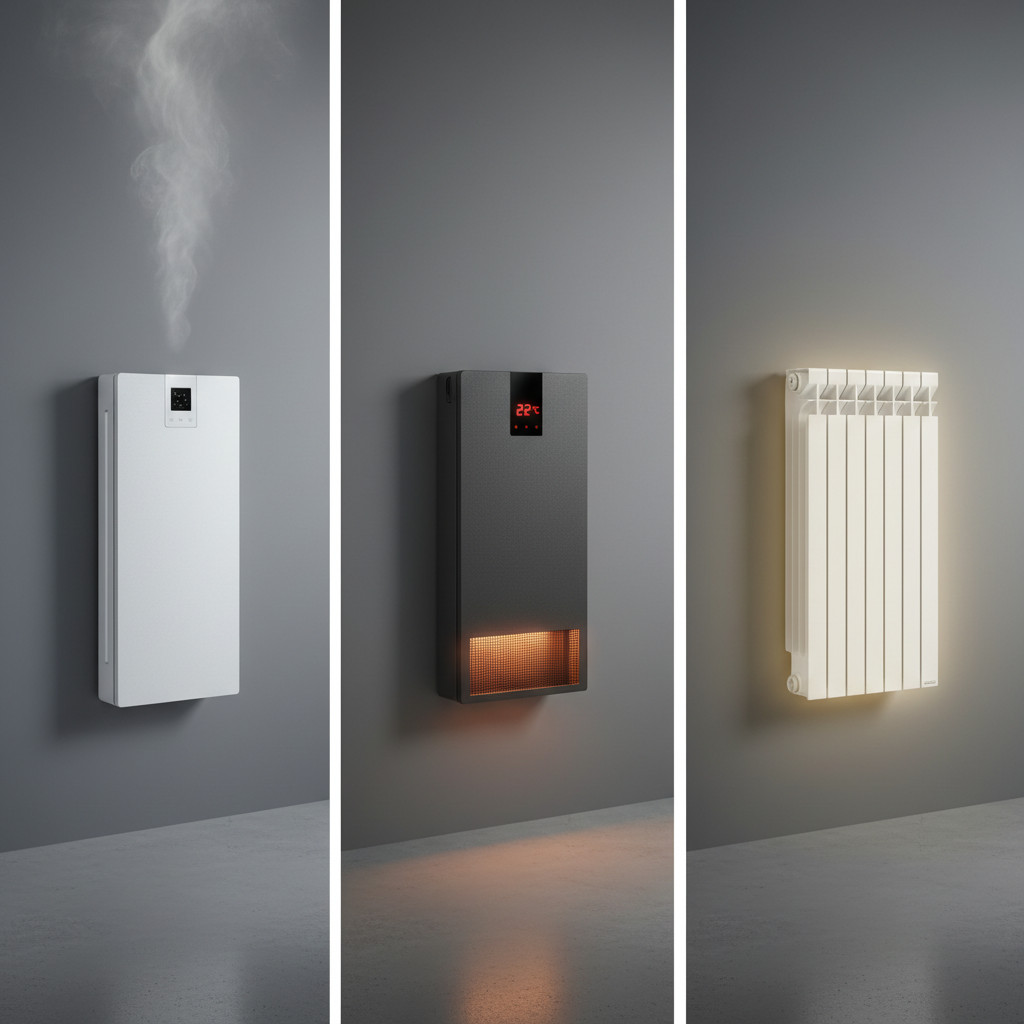
Electric panel heaters aren’t all built the same. They use different heating elements and methods to warm your room, each with its own set of pros and cons when it comes to a conservatory setting.
Convection Heaters
These are the most common and often the most affordable. Convection heaters work by drawing in cool air, passing it over a heating element, and then releasing warm air out the top. The warm air rises, circulates, and eventually heats the room.
- Pros: They heat up quickly, providing instant warmth. They’re generally lightweight and easy to install.
- Cons: Once you turn them off, the heat dissipates fast. They heat the air directly, which can feel less “deep” than radiant heat. They might also circulate dust.
- Best for: Quick bursts of heat, or for conservatories you only use for short periods.
Ceramic Core Heaters
These heaters use ceramic plates as a heating element. Ceramic is great at retaining heat. The heater warms the ceramic, which then slowly releases that heat into the room, often through a combination of convection and radiation.
- Pros: They’re very energy efficient for sustained heating. The ceramic core holds heat even after the element switches off, reducing power consumption. They provide a more consistent, comfortable warmth.
- Cons: They take a little longer to heat up initially compared to basic convection. They tend to be heavier and sometimes more expensive upfront.
- Best for: Conservatories you want to keep warm for extended periods, providing efficient background heat.
Oil-Filled Panel Heaters (or Oil-Filled Radiators)
While often thought of as portable radiators, slimline oil-filled panels are available for wall mounting. They contain a sealed oil reservoir that heats up. The oil retains heat exceptionally well, radiating it slowly and evenly into the room.
- Pros: They offer excellent heat retention and provide a very gentle, consistent, radiant warmth. They’re very efficient for maintaining a steady temperature.
- Cons: They take the longest to heat up. They can be heavier and bulkier than other panel types.
- Best for: Providing continuous, low-level background heat in a conservatory that you use regularly and want to keep consistently warm without big temperature swings.
For a small conservatory, a ceramic core panel heater often strikes the best balance between quick warmth and efficient heat retention.
Low-Profile and Dwarf Wall Heaters: The Perfect Fit
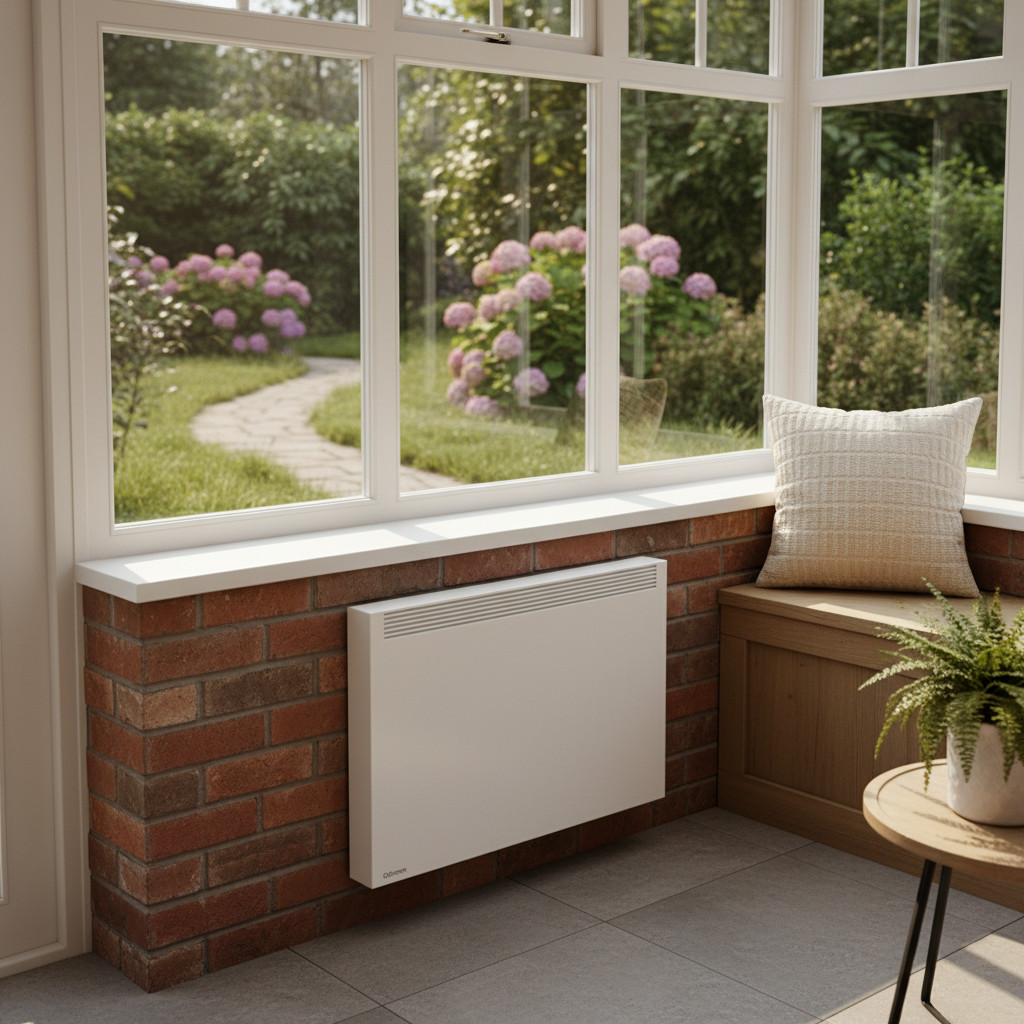
Conservatories so often feature dwarf walls – those shorter brick walls found right under the windows. Standard-sized wall-mounted heaters typically sit too high, either blocking your views or clashing with the overall aesthetics. This is exactly where low-profile or dwarf wall heaters truly become your best friend.
These heaters are specifically designed to be much shorter than typical models, often around 30-40cm (12-16 inches) in height. This makes them perfect for fitting neatly onto a dwarf wall without encroaching on your window space or blocking natural light. They usually come in various lengths to accommodate different wall sections.
Key Benefits:
- Aesthetics: They maintain the clean lines and open feel of your conservatory. You don’t want a big, bulky heater drawing attention away from your garden view.
- Space-Saving: By using the dwarf wall space, you free up precious floor area in a small conservatory.
- Targeted Heating: Placing the heater low can help warm the air at floor level, which is where cold drafts often settle in a conservatory.
When you’re looking for a heater, specifically search for terms like “low profile electric heater,” “dwarf wall heater,” or “conservatory heater.” Check the dimensions carefully to make sure the height fits perfectly under your window sills. Some brands even offer kickboard or plinth heaters, which fit directly into the base of cabinets or benches, though these are less common for wall mounting in conservatories.
Detailed Running Costs: What to Expect in a Small Conservatory
Understanding running costs is absolutely vital, especially since electricity can certainly be expensive. While we can’t give you exact figures (as electricity prices vary and everyone’s usage is different), we can compare the relative efficiency of different panel heater types and show you how to estimate them yourself.
First, your electricity cost is usually measured in pence per kilowatt-hour (p/kWh). Let’s assume a typical rate of 30p/kWh for our examples (you should check your own bill for accuracy).
Here’s how to calculate:
Cost per hour = (Heater Wattage / 1000) x Cost per kWh
Let’s use our example conservatory needing a 2000-watt (2kW) heater.
1. Basic Convection Panel Heater (2kW)
- Cost per hour: (2000W / 1000) x 30p/kWh = 2kW x 30p/kWh = 60 pence per hour
- Running Profile: Heats up fast, cycles on and off based on the thermostat. If your conservatory is poorly insulated, it might run more often.
- Estimated Daily Cost (e.g., 4 hours of active heating): 60p/hour x 4 hours = £2.40
2. Ceramic Core Panel Heater (2kW)
- Cost per hour (when active): (2000W / 1000) x 30p/kWh = 2kW x 30p/kWh = 60 pence per hour
- Running Profile: Takes a little longer to warm up, but the ceramic core retains heat. This means the heating element might switch off for longer periods once the room reaches temperature. Over time, it might need to “actively” run for fewer total minutes per hour to maintain the same temperature compared to a basic convection heater.
- Estimated Daily Cost (e.g., 4 hours of usage, but effectively running for 3 hours due to heat retention): 60p/hour x 3 hours = £1.80 (This is a simplified example, actual savings vary).
3. Oil-Filled Panel Heater (2kW)
- Cost per hour (when active): (2000W / 1000) x 30p/kWh = 2kW x 30p/kWh = 60 pence per hour
- Running Profile: Slowest to heat up, but the oil retains heat for a very long time. This makes it extremely efficient for maintaining a stable temperature. The element will run less frequently than a basic convection heater to keep the room warm.
- Estimated Daily Cost (e.g., 4 hours of usage, effectively running for 2.5-3 hours due to superior heat retention): 60p/hour x 2.5 hours = £1.50 (Again, a simplified example).
Key Takeaways for Small Conservatories:
- Insulation is King: The better insulated your conservatory, the less your heater needs to run, saving you money.
- Thermostat Control: A good, accurate thermostat is crucial. Set it to the temperature you need, and let the heater do its job. Don’t just blast it on full.
- Timer Functions: Use timers to pre-warm the conservatory just before you want to use it, and turn it off when you’re done.
- Heat Retention: Ceramic core and oil-filled heaters generally offer better long-term efficiency for sustained heat because they retain heat longer. If you’re using your conservatory for extended periods, these could save you money in the long run despite a higher initial cost.
- Zoning: Only heat the conservatory when you’re using it. Don’t try to heat it like a main room of your house if it’s not well-integrated.
By choosing the right technology and managing your usage wisely, you can keep your small conservatory cosy without shocking your bank account.
IP Ratings: Protecting Your Heater in a Conservatory Environment
Conservatories are truly unique spaces. They’re not quite indoors, not quite outdoors, and they often experience more humidity and temperature swings than a standard room. This means the IP (Ingress Protection) rating of your electric panel heater is something you genuinely shouldn’t overlook.
An IP rating tells you how well an electrical enclosure is protected against solids (like dust) and liquids (like water). It’s shown as “IP” followed by two numbers, e.g., IPX4.
- The first digit relates to solid particle protection (0-6, where 6 is dust-tight).
- The second digit relates to liquid ingress protection (0-8, where 8 is submersible).
- An ‘X’ means the product wasn’t tested for that specific type of protection.
Why IP Ratings Matter in a Conservatory:
- Condensation: Conservatories are prone to condensation, especially on colder surfaces. This means higher ambient humidity and potential for moisture to collect on or near electrical appliances.
- Rain/Splashes: If your conservatory has vents, or if a window is accidentally left open during a shower, there’s a risk of splashes or rain entering the space.
- Cleaning: You might wipe down windows or floors, potentially splashing nearby appliances.
Recommended IP Ratings for Conservatory Heaters:
For a typical conservatory, we recommend a minimum IP rating of IPX4.
- IPX4: This means the heater is protected against splashing water from any direction. It’s safe for use in areas where splashes might occur, which covers most conservatory scenarios.
What to look for:
- IP20: Standard indoor rating. Only protected against solid objects larger than 12.5mm. Not ideal for a conservatory.
- IP21: Protected against vertically dripping water. A slight improvement, but still not sufficient for splashes.
- IP24: Protected against splashing water from any direction. This is a good minimum for a conservatory.
- IP44 or IP54: Even better! The first digit protects against dust (4 = objects >1mm, 5 = dust protected). The second digit (4) still provides splash protection.
Always check the product specifications for the IP rating. Choosing a heater with an adequate IP rating gives you peace of mind that it can safely handle the unique environmental conditions of your conservatory, protecting both the appliance and your home.
Smart Home Integration: Beyond the App
Many modern electric panel heaters now come with their own dedicated apps for control, which is certainly convenient. But true smart home integration really takes things a step further. It means your heater can communicate with other devices and systems in your home, creating a far more seamless, automated, and energy-efficient climate control system for your conservatory.
Think about it: instead of just turning the heater on or off with its own app, you can integrate it into your broader smart home ecosystem.
How it Works and What You Can Do:
- Voice Control: Connect your heater to Google Home, Amazon Alexa, or Apple HomeKit.
- “Hey Google, set the conservatory temperature to 21 degrees.”
- “Alexa, turn on the conservatory heater.”
- This is super convenient when your hands are full or you’re just feeling lazy.
- Automated Schedules: While most heaters have built-in timers, smart integration allows for more complex scheduling.
- Set routines: “If it’s weekday at 5 PM and I’m home, warm the conservatory.”
- Link to your presence: Have the heater turn on when your phone detects you’re arriving home, ensuring a warm welcome.
- External Sensor Integration: This is a game-changer for conservatories.
- Use a separate smart temperature/humidity sensor placed in the conservatory.
- Set up rules (e.g., via IFTTT – If This Then That): “If conservatory temperature drops below 18°C, turn on the panel heater.”
- This can lead to more precise and responsive heating, only activating when truly needed, saving energy.
- Geolocation Triggers: Some systems let you define a geofence.
- When you leave a certain radius from your home, the heater can automatically turn off.
- When you re-enter, it can pre-heat the conservatory.
- Energy Monitoring: Some smart plugs or smart home hubs can monitor the energy consumption of your heater, giving you real-time data on how much power it’s using. This helps you track and manage your costs.
When choosing a smart panel heater, look beyond just “Wi-Fi enabled.” Check if it explicitly states compatibility with major smart home platforms like Google Assistant, Alexa, or supports IFTTT. This ensures you’re buying a heater that truly integrates into your smart home, not just one with a standalone app.
Managing Condensation and Ventilation in Your Heated Conservatory
Heating a conservatory can sometimes feel like a double-edged sword when it comes to condensation. While making the space warm obviously makes it more comfortable, it also means the air can hold more moisture. When that warm, moist air then hits colder surfaces (like single-glazed windows on a frosty morning), condensation forms. This can easily lead to dampness, mould, and an unhealthy environment if it’s not managed proactively.
Here’s how to tackle condensation and ensure good ventilation alongside your heating:
- Don’t Overheat: Aim for a comfortable temperature, but avoid making your conservatory excessively hot, especially if it’s poorly insulated. A moderate, consistent temperature is better than extreme fluctuations. Use your thermostat effectively.
- Ventilate Regularly: This is the most critical step.
- Short Bursts: Even on cold days, open a window or roof vent for 10-15 minutes, once or twice a day. This replaces humid indoor air with drier outdoor air without significantly cooling the structure.
- Cross-Ventilation: If possible, open windows on opposite sides to create a through-draft for quick air exchange.
- Trickle Vents: If your conservatory has trickle vents, make sure they’re open. They provide continuous, low-level airflow.
- Avoid Drying Laundry: Hanging wet clothes to dry in your conservatory releases a huge amount of moisture into the air, almost guaranteeing condensation. If you must, ensure intense ventilation during and after.
- Address Moisture Sources:
- Plants: While lovely, many plants release moisture. Group them, and consider moving some out if condensation is a major issue.
- Leaky Roof/Walls: Fix any leaks immediately. External moisture getting in will only make things worse.
- Use a Dehumidifier: For persistent condensation issues, a small dehumidifier can be a fantastic complementary tool. It actively removes moisture from the air, working in conjunction with your heater.
- Run it for a few hours after heating, or during periods of high humidity.
- Look for models with a humidistat that can maintain a target humidity level.
- Maintain Consistent Temperature: Allowing your conservatory to get very cold and then rapidly heating it up often makes condensation worse. Trying to maintain a more consistent, albeit lower, temperature can reduce the shock effect on cold surfaces.
By proactively managing ventilation and moisture, you can enjoy a warm conservatory without the downsides of dampness and mould. Your heater will provide the comfort, and good airflow will keep the environment healthy.
Key Features to Look For
Beyond wattage and technology, several features can make a big difference in how well your electric panel heater performs in a small conservatory:
- Accurate Thermostat: A precise digital thermostat is crucial for maintaining your desired temperature without wasting energy. Look for models with 0.5°C increments.
- Programmable Timer: Set it to come on before you use the conservatory and switch off when you don’t. Daily or 24/7 programming gives you maximum control.
- Open Window Detection: Some smart heaters can sense a sudden drop in temperature (like an open window or door) and temporarily switch off to avoid wasting energy. This is incredibly useful in a conservatory.
- Adaptive Start/Pre-Heat Function: This intelligent feature learns how long it takes to heat your room and starts warming up ahead of your scheduled time, ensuring the room is already warm at the time you want it to be.
- Anti-Frost Mode: A low-power setting that prevents the temperature from dropping below freezing (e.g., 5-7°C). It stops pipes from bursting and protects plants, even when you’re not actively heating the space.
- Wall-Mountable (and Feet Option): While you’ll likely wall-mount, having optional feet can be handy for initial placement testing or if you ever want to move it.
- Safety Features: Overheat protection and a tilt switch (if it’s a portable option that might be knocked over) are standard but vital.
- Child Lock: If little ones are around, a child lock prevents accidental changes to settings.
- Display: A clear, easy-to-read LED or LCD display makes programming and checking settings much simpler.
Top Picks for Small Conservatories
Instead of specific models, which often change yearly, let’s instead focus on the types of heaters that consistently perform really well in a small conservatory setting, drawing from our earlier discussions.
1. The Compact Ceramic Core Panel Heater
- Why it’s great: These are often slimline and provide a good balance of rapid heat-up and excellent heat retention. They’re efficient for maintaining warmth over several hours without constantly drawing maximum power. Many models now come with smart features.
- Look for: Models with a height that fits your dwarf wall, digital thermostats, and programmable timers. They’re a solid all-rounder.
2. The Low-Profile Convector Heater
- Why it’s great: If your primary need is quick, on-demand heat for short periods, a compact convector heater is ideal. They warm the air fast. Many are specifically designed to be low-height for conservatory walls.
- Look for: A good, responsive thermostat to prevent overheating, and consider models with silent operation if noise is a concern. Great for occasional use.
3. The Slimline Oil-Filled Panel Heater
- Why it’s great: For conservatories that are used regularly and require consistent, background warmth, these excel. They radiate a very comfortable, gentle heat that lingers. They’re energy-efficient over long periods due to their superior heat retention.
- Look for: Wall-mountable versions with a slim profile. Check the heat-up time if you need instant warmth, but understand their strength is sustained comfort.
4. Smart Wi-Fi Enabled Heaters (of any type)
- Why it’s great: Regardless of the heating technology, if you value convenience, energy saving through smart control, and integration with your home, prioritize models with robust Wi-Fi capabilities.
- Look for: Compatibility with major smart home assistants (Alexa, Google Home), open-window detection, and adaptive start features. These heaters really help you manage your conservatory’s climate intelligently.
Remember to match the wattage to your conservatory’s specific needs, and always check the IP rating for safety in a potentially humid environment.
Installation and Placement Tips
Getting your electric panel heater positioned in just the right spot makes a huge difference to both its effectiveness and your overall comfort.
- Wall Mounting is Best: For a small conservatory, wall mounting is almost always preferred. It saves floor space, reduces trip hazards, and often looks much neater. Most panel heaters come with wall brackets that are easy to install.
- Under Windows or on Dwarf Walls: This is often the most effective placement in a conservatory. Cold air tends to drop from the windows. Placing the heater below them helps to counteract this cold draft, creating a “warm air curtain” that rises and circulates, preventing heat loss and improving comfort. This is why low-profile heaters are so valuable.
- Avoid Obstructions: Don’t place furniture directly in front of the heater. This blocks the heat from circulating effectively and can make the heater work harder than it needs to. Allow some clear space around it.
- Near a Power Socket: While obvious, plan your placement near an existing power socket to avoid unsightly extension cords or the need for new electrical work. If you must use an extension lead, ensure it’s rated for the heater’s wattage.
- Away from Drafts (but not too far): While placing it under a window is good, avoid placing it in a direct, strong draft from a poorly sealed window or door. This will make the thermostat less accurate and the heater less efficient.
- Consider Air Circulation: Panel heaters primarily work by convection. For heat to spread evenly, it needs to circulate. Don’t trap it in a corner or behind heavy curtains.
- Professional Installation (for hardwiring): If you opt for a hardwired heater (which means it’s wired directly into your home’s electrical circuit rather than plugged into a socket), always use a qualified electrician. This ensures safety and compliance with building regulations.
Proper installation and thoughtful placement ensure your panel heater works at its peak efficiency, making your small conservatory a truly inviting space.
Frequently Asked Questions
Can I leave an electric panel heater on all the time in my conservatory?
It’s generally not recommended to leave any heater on constantly, especially in a conservatory that can lose heat quickly. Modern panel heaters with accurate thermostats and timers are designed to cycle on and off to maintain a set temperature. Using the timer to only heat the space when you’re using it, or when an anti-frost mode is needed, is much more energy-efficient and safer.
Are electric panel heaters expensive to run in a conservatory?
Running costs depend heavily on your electricity tariff, the heater’s wattage, how long it runs, and your conservatory’s insulation. Conservatories are less insulated, so they often require more heating. However, choosing an efficient ceramic core or oil-filled panel heater, using a good thermostat, and smart controls can significantly reduce running costs compared to basic convection models or leaving it on constantly.
What size electric panel heater do I need for a 3m x 2m conservatory?
First, calculate the volume. If your conservatory is 3m x 2m with a typical height of 2.4m, its volume is 14.4 cubic meters. For a conservatory with average insulation, you’d need around 100-120 watts per cubic meter. So, 14.4 m³ x 110 W/m³ = 1584 watts. You’d likely want a heater in the 1500W to 1800W range to ensure it can effectively warm the space.
Final Thoughts
Turning your small conservatory into a comfortable, usable space all year round is absolutely achievable with the best electric panel heater for your needs. It’s not just about picking up “a heater”; it’s about making a truly informed choice that carefully considers your specific conservatory’s size, insulation, and exactly how you plan to use it.
We’ve explored everything from calculating the perfect wattage to understanding various heating technologies, finding low-profile options for dwarf walls, and even integrating with your smart home. By paying close attention to details like IP ratings and effectively managing condensation, you’ll ensure your investment is safe, efficient, and genuinely makes a difference.
So, take your time, measure your space accurately, and think about the features that matter most to you. With the right electric panel heater, you’ll effortlessly transform that chilly glass room into a warm, inviting extension of your home that you can truly enjoy in any season.
